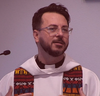
May I be the first to officially wish you a “Merry Christmas?” Before I begin a word of Welcome. Especially if church isn’t your normal scene. If you’re not sure what, or if, you believe, know you are welcome. Whether you are here because your parent or grandparent or child asked you to come (it is good to build up political capital at home), please know you are welcome. If you are here in church for the first time, or the first time in a long time, if you’re still not quite sure, that’s okay. I know the church has caused a lot of hurt, so please know, you are welcome. Whoever you are, wherever you are on the journey of faith, you are welcome here.
I once was in your shoes at St. Michael’s. The first Christmas Eve this congregation worshiped in this building, I sat back there on the banco at the late service. We were here visiting my dad’s family, his aunt lived just up the road. I was a teenager at the time. I remember I thought the banco was cool, and I remember watched as another teenager up on this banco, serving up at the altar was falling asleep. I didn’t know that one day, I would be back as a priest in this church. If you’re visiting tonight, you are very welcome. Who knows, one day you may be the rector.
Whatever brings you here tonight, welcome. Merry Christmas.
Have you heard that churches in Bethlehem announced they would not celebrate this Christmas season? In the midst of war in Gaza and Israel, there are no Christmas lights up in Manger square in the center of Bethlehem. There will be no fireworks. The Lutheran Church did put out its nativity set, and an image from the scene has been shared in the New York Times and across social media. I would guess many of you have seen the picture. This year, in Bethlehem, the Baby Jesus lays on a pile of concrete rubble.
That image stuck with me as I prepared for Christmas these last weeks. Partly, I think, because we were getting ready for our Christmas pageant. Our son was one of the shepherds at the service earlier tonight. I think sometimes we treat Christmas as a holiday for children. Having a five year old, I’ll say it is magic this time of year for him, and with him.
But this story, it’s not a children’s story. Even though we often hear the story told BY kids, this is not a story FOR kids. This is a very grown up story. This is the story of a young girl, pregnant out of wedlock. This is the story of a man who discovers his fiancé is going to give birth to a child that isn’t his. This is the story of an unlikely family who have to travel on foot and donkey from one side of the country to the other because their land is occupied by a foreign army. They have to register with their occupiers to be taxed. This is the story of shepherds who have a vision of the heavens which terrifies them. The Christmas story is a story of frightful decisions. The Christmas story is a story with sex and shame, terror and visions, and taxes. Hard to get all of that in a pageant. This is a grown up story.
God is born not in comfort, not in convenience, but in the midst of strife and doubt. No one in this story is deserving. No one is “worthy.” No one has earned their place.
On the cover of our bulletin is a painting by an iconographer named Kelly Latimore, La Sagrada Familia. In the image, Joseph, Mary, and baby Jesus are portrayed as Latin American immigrants somewhere near the U.S. Mexico border. I saw similar images painted on the walls of a shelter in El Paso for migrants recently. The image reminds us that the circumstances of Jesus’ birth, much like the circumstances faced by the families arriving to our country today, were frantic. Jesus’ family had to flee violence.
Too often Christians have taken the Gospel, which is meant to be “Good News of great joy for All People” and made it into Good News only for a select few. Too often, we Christians make our faith into a reward system for those who are able to conform to a set of particular standards, who have the money and the status to belong in very particular ways.
The story of Christmas tells us we don’t earn our way into God’s grace. Grace comes when we are most in need. God is there with us when we absolutely don’t deserve God’s presence. In fact, the whole economy of deserving and undeserving has nothing to do with God. God chooses to dwell with all the so-called wrong people. As the poet Madeleine L’Engle put it, “God did not wait til the world was ready…til [people] and nations were at peace. God came when the heavens were yet unsteady and prisoners cried out for release.” This is not a children’s story. Christmas is not tame. Christmas is not g-rated. Christmas is about the grace of God being born in the rubble of human lives.
God knows that in the midst of all the terror and difficulty of our lives, how much we need to be reminded: joy and love is always also possible.
A little over 30 years ago, just before Christmas, the author Toni Morrison wrote a eulogy for her friend James Baldwin. She talked about the power of joy that she learned from her friend saying how she wanted “to be generous enough to join your smile with one of my own, and reckless enough to jump in that laugh you laughed, because our joy and our laughter were not only right, they were necessary.” Joy and laughter are necessary, especially in the midst of sorrow and terror.
Toni Morrison goes on, “You knew, didn’t you, how I loved your love? You knew. This then is no calamity. No. This is jubilee. ‘Our crown,” you said, ‘has already been bought and paid for. All we have to do,’ you said, ‘is wear it.’” Toni Morrison reminds us, as James Baldwin reminded her, we do not have to earn joy. We do not have to earn laughter. We do not have to earn love. No, it is our birthright. Wear that crown, whatever your circumstances. Wear that crown of love.
Christ came to a people who were sore afraid. Jesus came in circumstances more frantic and worrisome than many of us will ever know. Yes, our world today knows sorrow. Yes, the news is difficult to bear. And in the midst of it, Love is born. Laughter is born. Joy will come to our world.
That image of the nativity scene this year in Bethlehem, it stuck with me this Christmas, so much that I had to keep returning to look. Maybe the third or fourth time I sat with the picture, I started to wonder why I was so focused on the rubble. It’s jarring, yes, but in some ways the nativity scene is simply more honest than most. If Jesus was born today, it wouldn’t be in a fancy maternity ward or birthing center. If Jesus was born today, the circumstances would be dire, just as they were a little over 2000 years ago.
As I looked at the image again, I thought, we often measure power in the ability to make rubble. We measure power in the capacity a person or a government has to tear down, to enforce their will with might. Christmas tells us, God’s power isn’t measured in making rubble. God came to show us that the true power, the power with the capacity to remake our world, is gentle, humble, vulnerable. The real power behind our world is love.
We seek to follow one who brought laughter and joy to frightened shepherds and scared new parents. God brought love to the terrified. We seek to follow the one who chose the worst of human circumstances into which to be born. We didn’t earn God’s presence. No. When we were at our worst, God came to love us.
If you came to church tonight seeking, know that here the best name we know for God is “Love.” As our presiding bishop says, “if it’s not about Love, it’s not about God.” In the midst of the rubble, in the midst of it all, love.
 Mike Angell