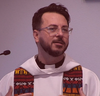
Click here for video
In the name of our loving, life-giving, liberating God.
Well hello St Michael’s. My name is Mike, and I am so glad to be here with you. Before I begin, I want to note, you all have been in this transition longer than I have, so let’s say thank you to your discernment team. Thank you to your vestry. Thank you to the welcome team who have already helped my family unpack boxes and cooked us meals. Thank you also to your clergy and staff who have been so gracious and patient with the new guy on the team. I am so glad to be here with you. Thank you.
This morning, we begin a new chapter in the Hebrew Bible. Really we begin a whole new book. Much of the summer, we have been hearing the stories of Genesis. Today we turn the page, to Exodus.
Exodus doesn’t begin with Moses: Shiphrah and Puah
It always strikes me that Exodus doesn’t begin with Moses. Moses is important, sure, but Exodus knows he isn’t the whole story. This first chapter is an origin story. Moses’ faith, his faith that will change the fate of his people, his faith predates him. Moses inherits a lineage of faithful
Lineage matters. What it means to be a Christian today is contested ground. What does it mean to be a person of faith? I suspect our neighbors have some wildly different answers to that question.
This morning, I want to suggest to you, if you want to know what it means to be a Christian, if you want to know what it means to believe in God, you have to look to your roots. Exodus doesn’t begin with Moses. Exodus isn’t about one leader who saves the people. Exodus is about the faith of the whole people. Moses’ faith, thank God, has deeper roots than Moses. Our roots stretch back to the faithful disobedience of Shiphrah and Puah.
Did you learn about Shiphrah and Puah in Sunday school? That we know their names at all is astounding. Most of the women in the Bible are remembered because they were the mother, grandmother, or sister of a male leader. That’s the patriarchy. But, astonishingly there are moments when the Bible breaks through its patriarchal setting.
Shiphrah and Puah are the first working women who are named. These are women working outside the home, for pay. They aren’t the mothers of a prophet or a king. We hear that they have families, but we don’t know anything about their descendants. Shiphrah and Puah are leaders in their own right. They set a pattern of faith that will define a people.
Shiphrah and Puah provide the context of liberation into which Moses is born. The midwives know that they have a sacred duty. Childbirth is holy work, messy work. Hard work. And holy work. These midwives know that the lives they protect, are more important than some law from a bigoted pharaoh who doesn’t understand healthcare. As St. Augustine once said, lex iniusta non est lex. Dr. King translated, “an unjust law is no law at all.” This Pharaoh, who did not know Joseph, who did not know how his own people were saved by the Hebrew people, this pharaoh who does not know his history, his ruling must be defied.
That is the lineage of our faith, those are our roots friends. We stand here, almost a quarter of the way through the 21st century, thousands of years after Shiphrah and Puah trusted God and defied the powers of their day. Our roots reach back to these faithful midwives. The Bible wants us to know their names, to know their faith.
Our Liberating God: the Centrality of Exodus
You heard me pray a prayer that comes from our presiding bishop, Michael Curry: In the name of our loving, life-giving, liberating God. Exodus tells us our God is a loving, life-giving, and liberating God. Do you know that a couple of centuries ago, there were missionary organizations that removed the book of Exodus from the Bible? Enslaved Africans were being taught a version of the Bible which included St. Paul but not the book of Exodus. Anglican missionaries printed so-called “slave Bibles” without the book.
It shouldn’t surprise us that today, after the Gospels, there is no book of the Bible more read in Black churches than the Book of Exodus. Tomorrow is the 60th anniversary of the March on Washington, of the “I have a dream” speech. Dr. King has been called the American Moses because he knew the roots of his faith, a faith with the power to set people free.
This question of roots is also at the heart of Jesus’ questions to his disciples today: “who do the people say that the Son of Man is?” and “who do you say that I am?” Peter’s answer is powerful: “you are the Messiah, the Son of the living God.” The answer is more powerful because Peter is being specific. The Messiah is the anointed one who is to continue the pattern of liberation. The Messiah is the one to set the people free. Don’t miss: the theological is also political.
Jesus and his followers are living under a new pharaoh, under Rome. Jesus knows how dangerous it is to be called Messiah, the anointed one of the liberating God. Jesus knows that a faith centered on setting people free will always upset the powers that be.
St. Michael’s and a Faith that Sets Folks Free
St. Michael’s, I am so grateful to finally be here with you. I need to tell you, as much as I love the Mountain West, as much as I love getting to move to the state where my family has some roots. (Like many of you, cattle-ranching brought my great grandparents and grandparents here to Albuquerque a century or so ago). As much as I love reconnecting, even as much as I love green Chile, that isn’t what has called me to St. Michael’s. I didn’t come here because I happen to share my name with the church, though it is convenient. You’re not likely to forget the rector’s name.
No, What called me here is your witness to our liberating faith. Through the search it was clear, this is a congregation that believes: Just as God called Shiphrah and Puah, just as Jesus called his followers: God is calling us to be about the work of liberation. I’ve known about this church for a long time.
I’ve had the privilege of serving with women you called to ordination decades before that was common. Women clergy leaders I knew talked about your rector Brian Taylor who sent them up to my childhood parish to get ordained when it wasn’t possible here. As a queer kid growing up in the Episcopal Church in Colorado, I also knew about this congregation in New Mexico standing up to its own bishop for the sake of the LGBTQ+ community. Ten years ago today Albuquerque made marriage equality legal, just a couple of weeks after Ellis and I were married in Washington, DC. I knew that St. Michael’s was performing some of the first marriages in the state. I read in your profile that Joe Britton allowed the rector’s office to be turned into a ministry welcoming asylum seekers and immigrants. On Thursday, with leaders from the Landing at a vigil in front of the immigration offices here, I got to meet some of the guests who talked about how life-giving it was, after inhumane treatment in immigration detention, to arrive here and receive kindness. I thought, that is the kind of church I want to join.
What called me to you, is your belief that our faith is rooted in standing up to pharaohs. I wonder whether we don’t hear about Shiphrah and Puah’s descendants because Exodus wants us to be their spiritual grandchildren. The Bible wants us, in our day, to take up the mantle of a defiant, loving, life-giving, liberating faith. I am so grateful for your call to walk with you. I am grateful to walk with a congregation which asks again and again:
How can your faith set you free? How can your faith set others free?
 Mike Angell