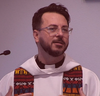
Each Sunday, at the top of the service, a priest prays a prayer we call a collect. I once heard someone explain, the prayer helps us collect ourselves for worship. As Jimmy Buffet, may he rest in peace, said “it’s a fine line between Saturday night and Sunday morning.” If you ask my dad, Buffet counted among the prophets. The collect helps us to cross the fine line, to go from who we are out there to who we are in here. The collect helps set the tone.
Many of collects are ancient prayers. They were chanted in Latin for centuries before the mass was translated to English. Thomas Cranmer the first protestant Archbishop of Canterbury, gave us the current form of most of these prayers, and in the case of today’s added one important word: “true.” A few moments ago, JP prayed that God might increase in us TRUE religion. Not just religion, true religion. What is true religion? What distinguishes true religion?
This morning’s lessons include two of the great icons of our faith. We read both of the burning bush and the cross. These two symbols are so iconic, that I worry we may have lost some of their meaning. I want to take a few minutes this morning to consider each symbol. Uncovering the fuller meaning of these signs may help us navigate our way to true religion.
So, first, what do you do if you encounter a burning bush?
New Mexicans know, a burning bush in a dry wilderness is a dangerous sign, and so it is no wonder Moses pays attention. “I must turn aside…and see why the bush is not burned up” Moses says. The fire does not consume the bush. A voice calls to Moses.
Have you ever found yourself on ground so holy it felt like you should take off your shoes? The burning bush, not consumed, is a powerful image. You can find it in stained glass and medieval paintings. I’ve seen sculptures, tapestries, even pastries with the burning bush motif. This sign can stand in, powerfully, for those moments of inexplicable encounter with the divine.
I know this parish has a fair number of contemplatives, folks who have dedicated themselves to practices intended to draw them nearer to God. I think of myself as an aspiring contemplative. The burning bush is an icon for the contemplative life, for those sought-after moments of breakthrough or deepening, for the great silences when we might find our inner one-ness with God.
My dear contemplatives, a caution, we must not stop reading at the first paragraph. We are so eager to hear God’s invitation to step barefoot onto holy ground. I worry, sometimes, about the contemplative side of Christianity when it is divorced from the call to justice. There is a balance in this passage if you keep reading.
Once God has confirmed for Moses who is speaking out of that burning bush, listen to what God says: “I have observed the misery of my people who are in Egypt. I have heard their cry…Indeed I know their sufferings.” Then, in one of the great turns of scripture God says, “I have come down to deliver them, so you Moses, you go to Pharaoh.”
I worry that when we paint, or sew, or sculpt a burning bush, when we sit in the quiet of a beautiful church waiting for the presence of God, that we might miss the next paragraph. When we take off our shoes in preparation for the spiritual encounter, are we also readying ourselves to put on our work boots?
Moses is given a vision but not only for his spiritual enrichment. Moses isn’t given God’s name as a reward for being a spiritual master. No, Moses is expected to take God’s name out in the world and use it to set people free.
Also, notice, before the encounter, Moses’ action is unbalanced. He is on the lamb having acted rashly in defense of his neighbor. Moses needs the holy encounter in order to ground the work. True religion involves both spiritual encounter and action for justice. They work together. God invites Moses onto the holy ground in order to send Moses out. The story of the burning bush is one where a forest fire doesn’t start, but Moses is sent to burn down the injustices faced by his people.
The Cross
There are two of our central signs in today’s scripture. The first is the burning bush, the second is the cross.
I wonder whether one of the greatest heresies the church has ever committed is to imagine that Jesus was crucified alone. European and white American theology has tended toward an understanding of the cross centered on Christ suffering FOR us. Latin American theology and Black theology tends to see the cross differently. Outside of the white church, the emphasis of the cross is less that Christ suffers FOR us and more that he suffers WITH us. Jon Sobrino, the Salvadoran Jesuit wrote of God’s crucified people. James Cone wrote about the cross as a lynching tree. As Americans, Cone said, we won’t understand the cross unless in it we can see a lynching tree.
What he means is this: Jesus’ fate was the same as so many of the people who live on this earth. People who die at the hands of the state, or at the hands of a racist mob, are victims of the same sort of death as Jesus. Christ suffers with the victims. People crucified by poverty, people crucified by the sins of homophobia, misogyny, ableism and xenophobia, people crucified by the greed of others, No one suffers alone. What is redemptive about the cross is precisely that God is present in the worst of human circumstances.
In the walls of the Church of the Holy Sepulcher in Jerusalem there are thousands of crosses, carved by pilgrims centuries ago. Many came seeking healing, for themselves or for others. Others came seeking forgiveness. The ancient graffiti speaks a truth I wish I could capture here on our reredos. I wish we had thousands of tiny crosses behind our great cross. I’m brand new here, and I’m making your property committee nervous. Maybe someday.
If you need a spiritual practice, when you see a cross, close your eyes. See thousands, millions of crosses. See the faces of those who have suffered. Christ’s cross does not stand on Calvary alone. The cross is not a symbol of Jesus’ uniqueness. No the cross is the opposite. The cross is the sign which reminds us that God is with us, all of us, in our worst moments. God is especially with those who suffer unjustly.
This Signs and True Religion
If my explication of this symbol is difficult for you, you’ve got good company. Just a few verses ago, in the lines we read last week, Jesus was congratulating Peter. He said to the disciple, “You are the rock on which I will build my church.” Then, here, just a few verses later, “get behind me satan.” Jesus’ harsh rebuke comes because Peter doesn’t want Jesus to suffer. Peter, presumably, also does not want to pick up his own cross. I feel for Peter. As Daniel Berrigan once said, “if you want to follow Jesus, you better look good on wood.” Our faith is more about surviving the journey than reaching a point of arrival.
Jesus needs Peter to know: the sign of the cross points us, like the burning bush, to true religion. True religion isn’t polished. True religious leaders are often humbled. Moses is a mess. Peter gets it wrong at least as often as he gets it right. Don’t buy religion from someone who pretends to be perfect.
There is a great deal of false religion out there. It hurts my heart that so much of the church does not center God’s love. Faith is not supposed to be about hating the right constellation of people. Faith is not supposed to be about hating yourself. The Gospel is about learning to love your neighbor and to love yourself. Church isn’t for people who have it all figured out. Church is a place to come if you need forgiveness, and mercy, and companions for the journey.
Because true religion doesn’t leave us alone. The signs of our faith point us back to one another, back to the work of feeding the hungry, accompanying the afraid, freeing the captives. True religion asks us to forgive our neighbors shortcomings and our own.
When we encounter the holy ground under burning bushes, when we survey the cross, we are sent back out to do God’s work. Because God still hears the cry of the suffering, the great signs of our faith point us not only up toward God, but out to stand with God’s people. We are sent to share God’s loving solidarity with the world. That is what makes religion true. May God increase in us true religion. Amen.
 Mike Angell
WOW! Thank you, Mike. I’m going to share this with our current rector, Janine Schenone. I’m pretty sure she’ll appreciate it. Maybe even build a sermon on it, who know?
Blessings,
Verdery