We’re late to the party this morning, for the Feast Day of our Lady of Guadalupe. Last week, Tuesday December 12, millions descended on the Shrine in Tepeyac, just a little north of downtown Mexico City.
As you enter the basilica, there is a priest waiting outside for you. The setup looks a little like an animal exhibit in a modern zoo. The clergy member is not in a cage, but a moat separates the priest from the people. The priest holds a broom of sorts, which is dipped into the water to bless the people and their outstretched icons and images of the Virgin. Above the priest and the moat is a massive sign that reads “Bendiciones.”
Now, if you grew up in a tradition that taught that images were suspicious, you might find today questionable. Questions are good. This is a church where you can lean into the questions that lead you deeper into the mystery of God. I’ll voice one question for you. This is a question that comes with a lot of White Anglo-Saxon Protestant baggage: “is celebrating the Virgin of Guadalupe idolatry?” I won’t ask for a show of hands, but I would imagine some of us are holding that question today.
Idol or Icon?
Let me go to a trusted source. The Latine theologian Orlando Espin says we often confuse the idea of an idol and an image. Throughout Christian history there have been moments and movements seeking to tear down all the images within churches. There can be something powerful in iconoclasm. It can be powerful to tear down the old images of God, to strike out the masculine, white, domineering understandings we’ve inherited. But an image, according to Orlando Espin, is not on its own automatically an idol. After all, we Episcopalians love stained glass. We’re comfortable even with statues of Biblical figures. At Christmas we bring out our nativity sets. Images on their own aren’t problematic. Golden cows aren’t even a problem, until they become a substitute for God. What makes an idol an idol is when it purports to stand in for God.
The theologian spells this out a little bit more saying that when we try to make any one image absolute, when we try and say we have THE definitive picture of what God is like, that is when we are treading on idolatrous ground.
Professor Espin flips the script on idolatry. If this or that particular image offends or upsets you, because you feel it can’t be of God, then you may have a problem with idolatry. You may be holding too tightly to your own image of what God must look like. How many of us have certain MUSTS when it comes to faith or religion, or the celebration of Christmas. It MUST happen this particular way. Watch our. When there is no room for mystery, when there is no room for wonder, when there is no room for surprise, when there is no room for God to show up in the unexpected, that is when you’re in danger of idolatry.
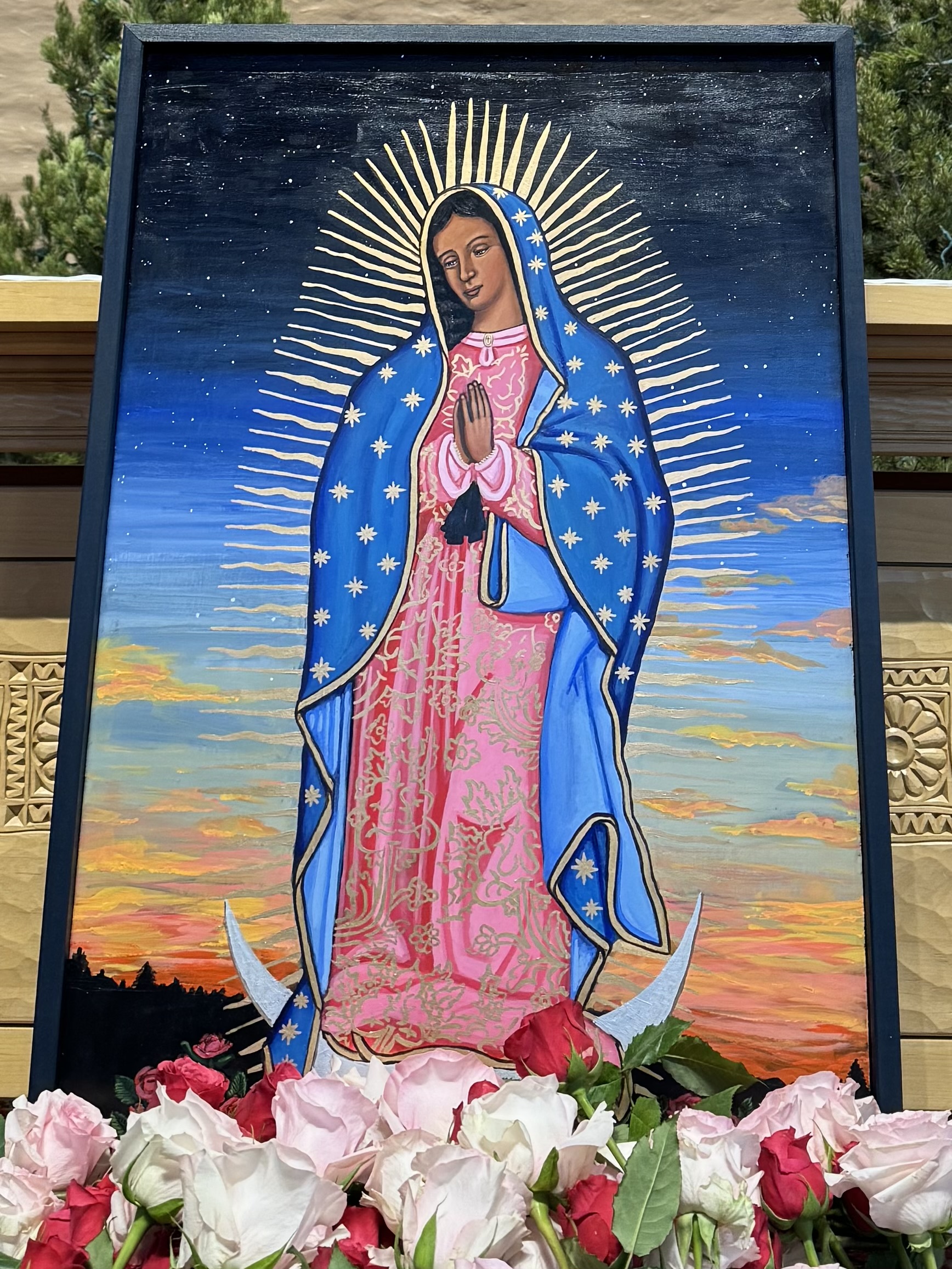
The icon of Our Lady of Guadalupe you see before you was written by an iconographer named Kelly Latimore. At my previous church we had another icon of Kelly’s, which he named “Mama.” There’s a copy hanging right now on the wall of the pavilion. You can visit after the service. “Mama” is a pieta, an image of Mary holding the body of Jesus. Kelly wrote Mama after the death of George Floyd. “Mama” was Floyd’s last word.
When images of Mama went up online, Kelly Latimore received death threats from fellow Christians. A group of traditionalists called Mama idolatry. Orlando Espin would say, “hold on, what makes an idol an idol is that it limits your perspective on the divine.” What is idolatrous, then, is not representing Jesus as a black man. Idolatry is being so attached to a European colonial image of God that you can’t see Jesus in another face.
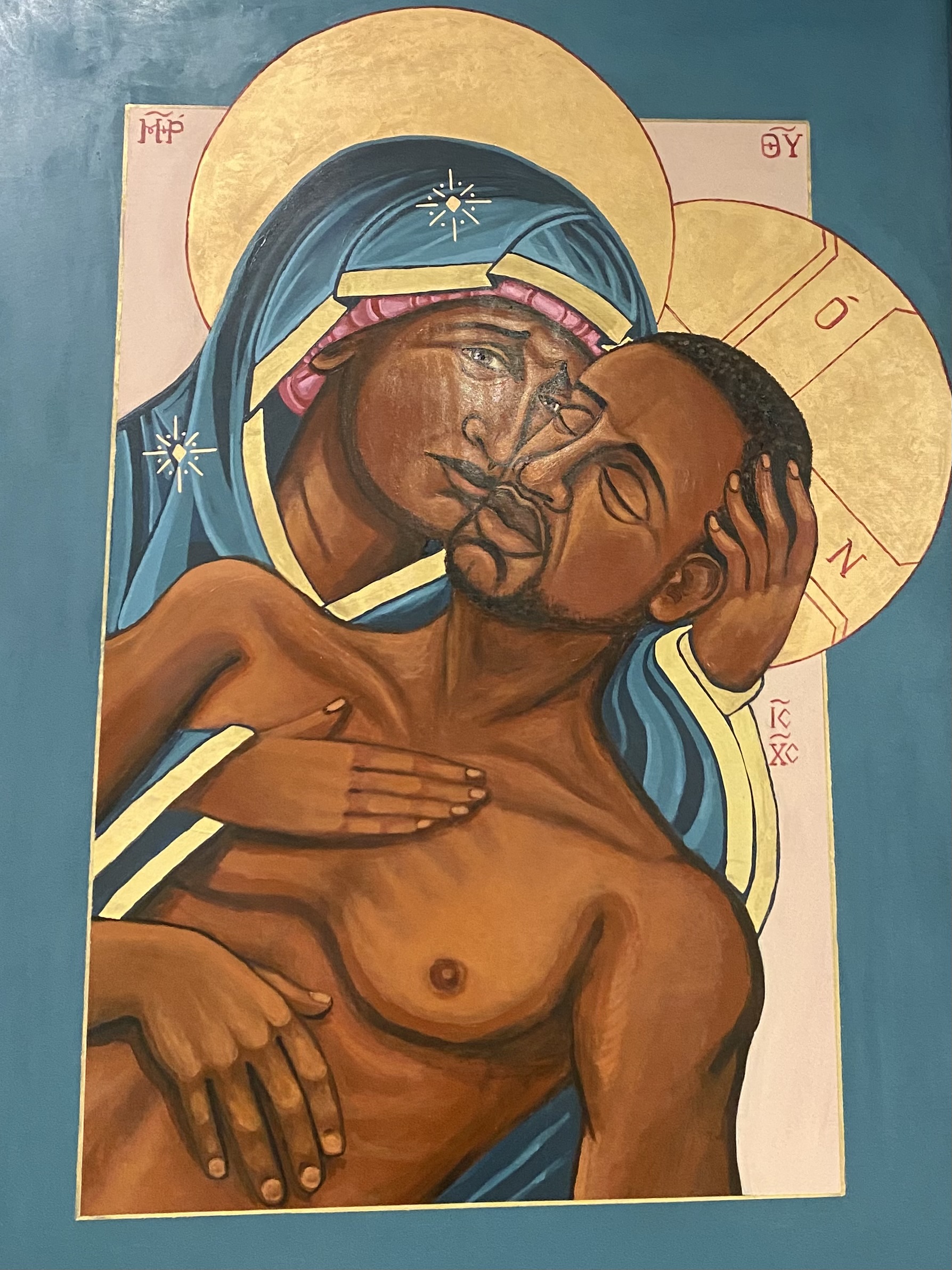
The difference between an idol and and icon is how we hold the image. Idols simplify, icons complexify. Idols are held tightly. Idolatry is about control, fencing, building walls around what we think is God’s. Icons do the opposite, they ask us to open our minds and hearts. An icon helps us to see God in unexpected places, in unanticipated faces.
As we read in today’s Gospel, the people have many questions of John the Baptist. He points again and again beyond himself. “It isn’t me you are looking for” he says. As the Zen Buddhist teaching has it, “I am just a finger pointing toward the moon.” Don’t confuse the finger and the moon. What John gets right is to point out beyond himself. In that way he is an icon of what is to come.
So what about Our Lady of Guadalupe?
What I find so compelling about the Virgin of Guadalupe is all of the unexpected. She appears not to the bishop in his Cathedral, as we might expect, but to Juan Diego, the poor Indian peasant on a hillside where the moon goddess was once worshiped. She does not look like the Mary images that the conquistadores brought with them. Guadalupe incorporates imagery from the Aztec. She is la morenita: she has dark skin. She looks like an indigenous woman. Though the Christian faith was brought to his people at the tip of a sword, Juan Diego encounters the mothering love of God speaking to him on the hillside. Jesus’ mother assures him and his people, she is their mother too. Guadalupe did more to convert the indigenous peoples of Mexico than 1,000 Franciscan friars. Because she assured, Gods love is for you too.
The Virgin of Guadalupe is a story which points us back to the wider divine story. We know that Jesus was often criticized by the powerful, by religious authorities, for sharing his table with all the wrong people. Jesus spent too much time, in their minds, with the poor, with those of ill-repute, with those the world ignored. In the story we tell next week, God is not born in a palace, with a retinue of servants and guards. God is born in the antic outpost of empire, among shepherds and livestock. Mary herself sang, the mighty are cast down from their thrones. God lifts up the poor and the needy. God often chooses those on the edges to be the center of divine action. If you are feeling edgy, watch out. That’s when God shows up.
When it was time for the Mexican people to claim their independence from colonial Spain, Padre Hidalgo chose the Virgin of Guadalupe as his banner. She is a sign that God’s vision of who we are is bigger than national identities or oppressive regimes. And the Virgin of Guadalupe continues to show up in unexpected places, on belt buckles and cowboy hats, on bumper stickers and the sides of buildings. I recently found a magnet in old town that I had to purchase for our fridge. I love cheeky religious humor. This magnet said, “in Guad, G-U-A-D, we trust.”
The Virgin of Guadalupe shows up in all sorts of unexpected places to help us to know that we do not have control over God, over where God appears.
A friend in seminary once shared a story of the leader of a Sufi Muslim movement. Shayk Nur al-Jerrahi, also known as Lex Hixon, was called to found a new branch of Sufi dervishes. But before he could begin, he made pilgrimage to the shrine of our Lady of Guadalupe, because she represented for him the spiritual protector of the Americas. Hixon had studied with Lakota Sioux teachers as well, and the idea of honoring the land and the ancestors may have played a role in his pilgrimage. Only after praying at Guadalupe’s shrine did he feel he could begin the new spiritual work on this continent. Our Lady of Guadalupe defies even our religious categories.
The image of our Lady of Guadalupe can be an icon, if she helps us to see the ways that God nurtures and protects us all. La Virgen de Guadalupe tells us, “God is with us. God cares for us as a mother.” God knows we Christians need more divine feminine imagery. God nurtures and does not abandon. She points us to the unexpected love of God. Deep down, how many of us still need to learn to expect God’s love?
Well, if you still have questions about the Virgin of Guadalupe, good. At its best, I think our faith invites us to wrestle with questions, to see more mystery not less.
I’ll finish with a personal story. We visited her shrine in 2019, and while my first impression was of the priest on exhibit with his blessing water and broom, my last impression was the wind.
The modern basilica where the original icon of the Virgin is held is huge, one of the largest religious spaces in the world, and most days it is open to the elements. A warm breeze blew through the main entryway as I stood and prayed. Just a few days earlier, Ellis and I had learned that we were going to interview to adopt a nine-month old boy. We didn’t know for sure at the time, but we were in the process of becoming Silas’ parents. Standing there in a basilica, on the precipice of the hill of Tepeyac, the warm air had a life of its own. It felt like vibrant winds of change. And somehow in that warm breeze, I also found assurance, that God would be with me, would be with us, in the unknown steps ahead. In all of the unexpected, we would be nurtured, cared for, loved. Bendiciones indeed.
 Mike Angell
kelley latimore preached today at HC. I did not agree with his assertion that Mary composed the Magnificat, but… i still appreciated several of the comments he made about the nature of the poem